

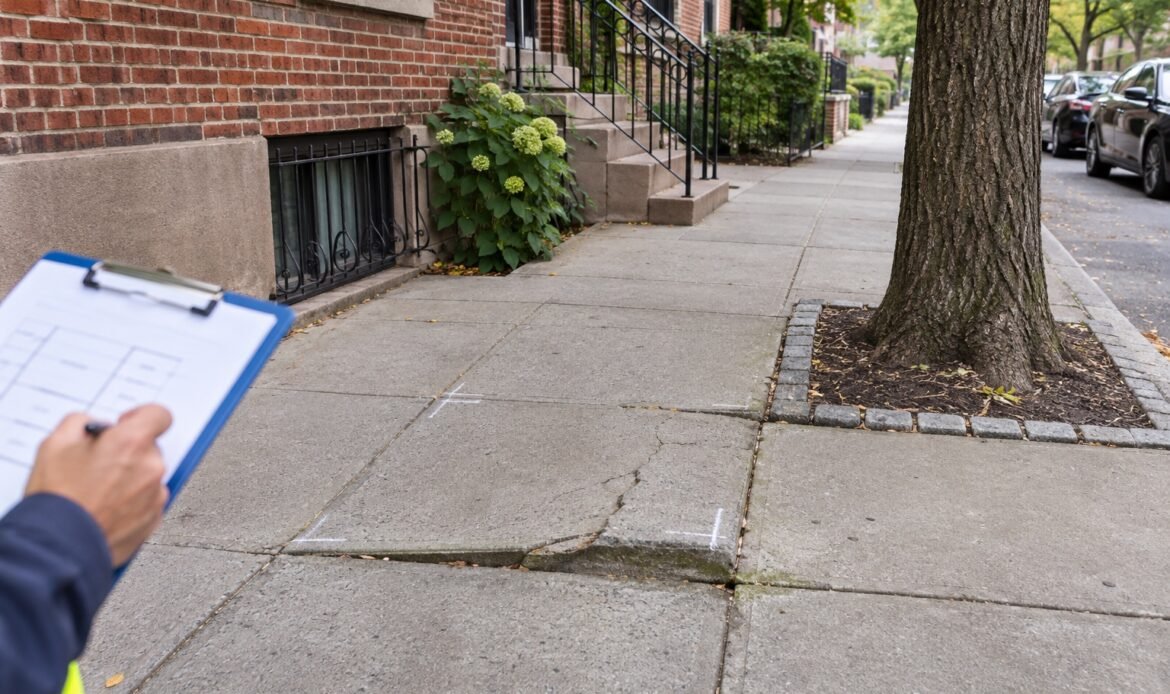
A sidewalk violation leaves a property owner with two jobs: organize the right repairs and follow through on the dismissal process. The clearest starting point is a written scope tied to your notice, followed by a quote that explains the work and a named person responsible for requesting the inspection.
This guide helps NYC homeowners and property managers compare repair proposals and keep the paperwork moving.
Start with the notice and inspection sketch
Confirm that the notice comes from NYC DOT. If it concerns the Department of Buildings instead, use our separate guide to resolving NYC DOB violations.
DOT says a sidewalk violation carries no fine, but the notice stays on file with the County Clerk until the City confirms satisfactory repairs. DOT also states that owners have 75 days after receipt to make repairs; obtaining a permit does not extend that period. Check your notice promptly against DOT’s current sidewalk guidance.
If the inspection report, cited defect, or property details do not match the sidewalk, current DOT guidance allows the owner to request a reinspection within that 75-day period. A different inspector performs the reinspection, and DOT states that the resulting decision is final. Preserve the notice, inspection report, dated photos, and any written response.
Create one project folder containing the notice, its Preliminary Inspection Report, dated photos, and correspondence. Photograph the full frontage and individual problem areas. Include the doorway, driveway, tree pit, and neighboring sidewalk transitions so a contractor can understand where each close-up belongs.
Write the receipt date on your working copy and ask each bidder when they can assess the property. Keep the original notice unchanged.
Turn the cited defects into a measurable repair scope
Walk the inspection sketch with the contractor. DOT says every numbered sidewalk flag on the report must be replaced and defects corrected unless the City confirms a property-specific exception or alternate resolution.
Tree-related damage follows a separate path. NYC says qualifying one-, two-, and three-family residential properties may receive free repairs when City-owned tree roots caused the damage, while four-or-more-unit properties, commercial buildings, and vacant lots generally remain responsible for adjacent root-related defects. Do not cut or shave City-owned roots; coordinate any work around them with NYC Parks. Review NYC311’s current tree-and-sidewalk guidance before pricing that scope.
Ask the contractor to mark the proposed repair boundaries on a copy of the sketch. Then separate three things: work included in the fixed price, conditions that need investigation, and optional improvements you are considering.
For example, replacing damaged sidewalk squares and upgrading a private entry path may be coordinated together, but each should have its own quantity and price. That distinction helps you compare bids and decide what can wait.
For help discussing the construction scope, explore BluRock’s concrete and masonry services.
How to compare NYC sidewalk repair cost proposals
There is no reliable project budget without measurements and site conditions. A price per square foot is useful only when both proposals cover the same work.
NYC311 lists a sidewalk repair permit fee of $70 for up to 300 linear feet at one property, checked November 2, 2026. Corner properties need two permits when work covers both sides. The fee covers administration and the dismissal inspection, not construction. NYC311 states that the contractor must obtain the DOT sidewalk opening permit before work begins and that sidewalk repair costing more than $200 must be performed by a contractor holding a DCWP Home Improvement Contractor License. Confirm the contractor’s current license and permit responsibility before comparing proposals. See the sidewalk construction permit guidance and sidewalk violation and repair guidance.
Use this comparison table when reviewing private contractor proposals:
| Quote item | What to ask the bidder to write down | Why it helps |
|---|---|---|
| Repair quantities | Measured area and a marked sketch | Shows whether bids cover the same footprint |
| Demolition and disposal | Removal limits, loading, and debris disposal | Prevents an incomplete removal allowance |
| Base and concrete | Preparation, specified thickness, and finish | Makes construction assumptions visible |
| Interfaces | Treatment of driveways, tree pits, covers, and adjoining surfaces | Identifies details hidden by a single unit price |
| Site arrangements | Access, pedestrian protection, and cleanup responsibilities | Clarifies how the property will function during work |
| Changes and closeout | Written change approval, inspection coordination, and final records | Establishes who handles unfinished decisions |
Suppose two proposals both include 160 square feet. One includes base preparation; the other says “as needed, additional.” Those totals do not describe the same commitment. Ask the second bidder how extra work will be measured, priced, photographed, and approved before accepting the proposal.
Keep a separate allowance for unresolved conditions instead of treating the lowest quoted total as a complete budget. Ask what would trigger that allowance and who must approve its use. Neither a permit fee nor an online average substitutes for a property-specific estimate.
Prepare for dismissal before construction finishes
Put inspection coordination in the agreement. Specify who will request it, who will receive updates, and how the owner will receive the final result.
DOT’s dismissal inspection checklist calls for corrected defects, a permit, compliant expansion joints, and a fully visible sidewalk. It also addresses detectable warnings when pedestrian ramps are repaired. Ask the contractor to review the complete checklist and applicable specifications during planning.
Use this document and closeout checklist:
- Keep the notice, marked scope, signed proposal, and approved changes together.
- Save permit details, invoices, and dated completion photos.
- For the 311 dismissal-inspection request, have the permit number, address, block and lot, violation number, and contact details ready, as listed in DOT’s checklist.
- Record the request confirmation and the person tracking it.
- Save the inspection outcome; if more work is required, document the remaining scope and next action.
A useful final walkthrough follows the same marked sketch used for the quote. Compare each planned repair with the completed work, then discuss any open items while everyone has the same reference in hand.
Frequently asked questions
Does a finished sidewalk automatically mean the violation is dismissed?
Do not assume it does. Follow the inspection-request process in DOT’s checklist and retain the official outcome in your property records.
What if the inspection report does not match my sidewalk?
Do not ignore the notice. Current DOT guidance allows an owner to request a reinspection within 75 days when the cited defect or property details do not match the sidewalk. Follow the current NYC311 appeal process, keep the notice and photos, and retain the final written result.
Can I compare quotes using only a square-foot price?
Use that price alongside a written scope. Quantities, preparation, interfaces, exclusions, and change terms determine whether the proposals are comparable.
What should I send when requesting a quote?
Send the notice, inspection sketch, property address, frontage photos, and preferred timing. Identify access restrictions and any separate improvements you want priced.
Ready to discuss your sidewalk repair scope? Contact BluRock Services with those details to start a practical project conversation.