

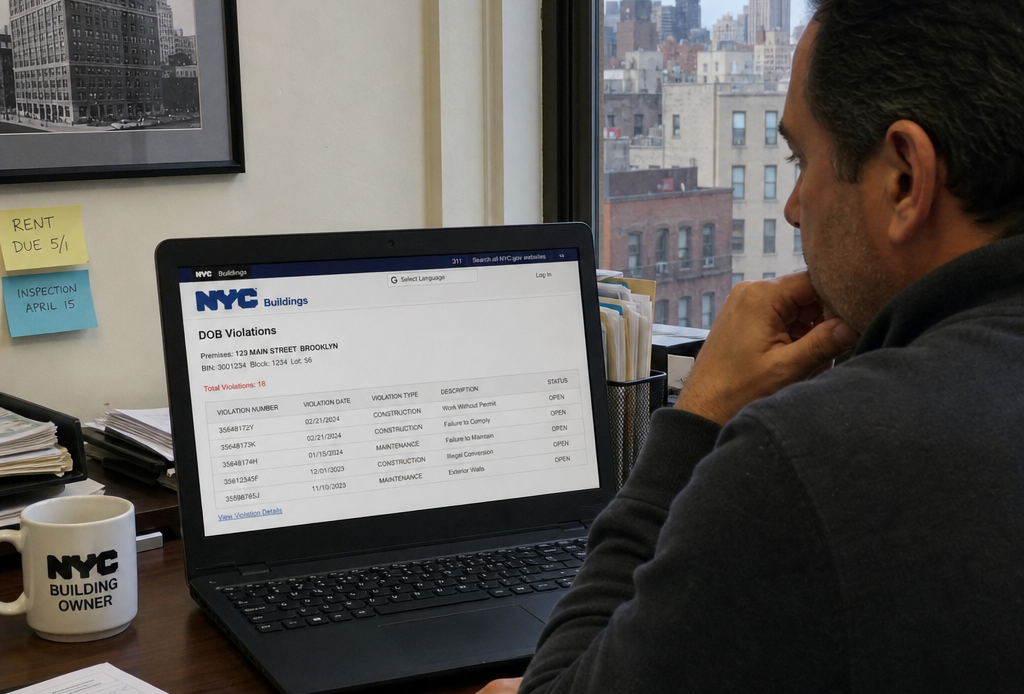
NYC DOB violations can feel intimidating, but most follow a practical sequence: find the violation, understand whether it is a DOB violation or an OATH summons, correct the condition, pay or contest the required penalties, and submit acceptable proof of correction. The key is not to stop after paying a fine; many NYC DOB violations remain open until the Department of Buildings accepts documentation showing the condition has been fixed. Open violations can affect sales, refinancing, permits, Certificates of Occupancy, and title review, so a clean record matters. (DOB violation resolution guidance)
What should you do first when you discover a DOB violation?
Start by confirming exactly what was issued, where it appears, and what deadline applies. A property may have DOB violations, OATH summonses, boiler issues, elevator issues, façade matters, or other NYC property violations that require different forms, units, evidence, and payment steps. As you arrange any urgent corrective work, gather the violation number, issue date, class, issuing unit, hearing date if any, and the building’s official records in DOB systems.
A practical first review should include:
Search the property record. Search DOB’s Buildings Information System (BIS), DOB NOW, and other applicable public portals to see what is open.
Read the violation language carefully. Identify the cited condition, location, code section, respondent, and whether the issue involves work without a permit, unsafe conditions, missing inspections, or filing failures.
Determine whether there is an OATH hearing. OATH summonses are handled through the city’s administrative hearing process, while some DOB violations do not require a court or OATH appearance.
Check the violation class. For DOB-issued OATH summonses, Class 1 is immediately hazardous, Class 2 is major, and Class 3 is lesser. Class 1 conditions require immediate correction. Check the applicable correction, cure, and hearing dates on every summons.
Look for related issues. One illegal renovation can trigger NYC building violations, permit problems, electrical or plumbing sign-offs, and inspection failures at the same time.
Create a file. Save copies of summonses, photos, permits, contractor invoices, inspection reports, correspondence, and payment confirmations.
This early sorting step prevents a common mistake: treating every DOB notice the same way. Some items can be resolved with a filing and photos. Others require permits, licensed trades, inspections, legalization, professional certification, or a hearing defense.
DOB violations and OATH summonses are not the same
The phrase “NYC DOB violations” is often used loosely, but the distinction matters. DOB inspectors may issue an OATH summons when a property or construction condition violates the Construction Codes or related rules. OATH is the city’s independent administrative law court, and it hears summonses issued by agencies such as DOB. (DOB’s OATH summons guidance)
A DOB violation, by contrast, may appear directly on the DOB record without a hearing requirement. It can still be serious, public, and disruptive. DOB states that open violations can interfere with selling or refinancing, and the agency will not issue new or amended Certificates of Occupancy or Letters of Completion while active DOB violations remain unresolved. (DOB violation resolution guidance)
Think of it this way:
OATH summons: Usually involves a hearing, admission, stipulation, dismissal, default risk, and penalties assessed through the administrative process.
DOB violation: Usually requires correction and proof submitted to the proper DOB unit, and may involve civil penalties depending on the violation type.
Both: Can require correction of the physical condition and agency acceptance of the required proof. A hearing outcome and a DOB correction status are separate parts of the process.
That final point is crucial. Paying DOB violation fines does not automatically clear the property record. If DOB requires a Certificate of Correction or proof package, the violation can remain open until that package is approved. (OATH failure-to-comply guidance)
Common causes of NYC DOB building violations
Most NYC DOB building violations come from a gap between the property’s actual condition and what DOB records, permits, codes, or safety rules require. Some are the result of active construction. Others come from long-standing conditions that surface during inspections, title searches, refinancing, complaints, or due diligence before a sale.
Common causes include:
Work without proper permits. Interior renovations, structural changes, plumbing, electrical, mechanical, and occupancy-related changes often require NYC permits before work begins.
Unsafe construction site conditions. Missing guardrails, improper sidewalk protection, unsafe scaffolding, or poor housekeeping can trigger DOB enforcement actions.
Failure to maintain the building. Deteriorated façades, unsafe boilers, defective elevators, blocked exits, and damaged structural components can lead to violations.
Unapproved occupancy or layout changes. Converting basements, cellars, garages, or commercial spaces without approval can create building code compliance issues.
Missed inspections or filings. Boiler, elevator, façade, gas piping, benchmarking, and other recurring compliance obligations may generate violations when deadlines are missed.
False, incomplete, or rejected correction paperwork. A condition may be fixed physically, but if the proof is weak or the form is wrong, DOB may reject the correction.
The cause affects the solution. A missing annual filing may be resolved through documentation and payment. An illegal conversion may require plans, permits, inspections, and possible restoration work. A hazardous construction condition may require immediate field correction before the paperwork can catch up.
How do you remove DOB violations in NYC?
To resolve NYC DOB violations, you generally need to correct the violating condition, document the correction, pay or resolve required penalties, and submit the correct proof to DOB or the proper unit for approval. For OATH summonses, you may also need to attend or respond to the hearing unless the matter can be resolved another way. For DOB-issued OATH summonses that have not been dismissed, a Certificate of Correction generally establishes that the cited conditions were corrected. (DOB Certificate of Correction FAQ)
DOB’s current online process uses attestations in place of notarized correction statements. The AEU2, AEU20, and AEU3321 forms are no longer uploaded separately. Check the current Certificate of Correction instructions before preparing your submission.
Use this step-by-step sequence to organize the resolution process:
Identify every open item. Search the property in BIS, DOB NOW, OATH records, and any relevant compliance portals. Do not rely only on a title report summary.
Separate violation types. Group items by OATH summons, DOB violation, boiler, elevator, façade, fire safety, work without permit, or other category.
Confirm deadlines and penalties. Check the summons or violation record for the class, hearing date, cure date, civil penalty, and any daily or default penalties.
Decide whether to admit, contest, or cure. If the violation is accurate, correction may be the priority. If you believe a charge is incorrect, review the evidence and the available procedures for contesting it. Correcting a condition after it was cited does not automatically eliminate liability.
Obtain required permits. If correction work itself requires permits, do not create a new violation by doing unpermitted repairs.
Correct the condition. Hire qualified contractors or licensed professionals where required. Keep dated photos before, during, and after correction.
Pass required inspections. Some violations need DOB inspections, licensed professional sign-offs, special inspections, or specialty agency documentation.
Pay or resolve penalties. DOB civil penalties must be paid or waived where applicable before DOB approves certain Certificates of Correction. (DOB Certificate of Correction FAQ)
Submit proof of correction. For a DOB-issued OATH summons, submit a Certificate of Correction Review Request through DOB NOW: Safety under “Violations & Notices of Deficiency.” Complete the required attestations and upload supporting evidence, such as photos, permits, inspection results, and proof of applicable penalty payment or waiver. Follow the issuing unit’s instructions for other DOB violation types.
Track the status until approval. A submission is not the same as clearance. Monitor the record and respond quickly to objections, rejections, or requests for more documentation.
For many owners, the hardest part is not the physical repair. It is matching the right evidence to the exact violation language. If a summons says a required sign was missing, a close-up photo of the corrected sign may help. If the issue is unpermitted construction, DOB may expect permits, drawings, inspections, and proof that the work was legalized or removed.
Timelines, penalties, and default risks
Timelines depend on the violation class and the correction required. Class 1 immediately hazardous summonses require immediate correction. OATH’s failure-to-comply guidance says Class 2 and Class 3 conditions must be corrected within 40 days of receiving the summons. Check your summons for the applicable correction, cure, and hearing dates, and do not wait for the hearing to begin corrections. Uncorrected conditions can lead to further enforcement and penalties. See OATH’s failure-to-comply guidance.
A correction deadline is not the same as eligibility for a zero-penalty cure. A cure is an admission to the summons. If your summons is eligible, submit an acceptable Certificate of Correction by the cure date and select the Cure Request option in DOB NOW: Safety. Standard correction approval alone does not excuse attendance at a required hearing. Review DOB’s cure and hearing guidance for the applicable options.
Typical resolution timeframes look like this in practice:
Simple paperwork violations: Often faster if the owner has records, payment confirmation, and the correct forms ready.
Minor physical corrections: May take days or weeks, depending on access, contractor availability, and whether DOB inspection is needed.
Permit-related violations: Often take longer because plans, filings, objections, approvals, inspections, and sign-offs may be required.
Complex legalization matters: Can take months when unauthorized work must be legalized, altered, or removed.
Hazardous violations: Require immediate action first, followed by documentation and agency approval.
Penalties also vary. Some DOB violation fines are fixed by schedules, some depend on violation class, and some increase if a respondent misses a hearing or fails to certify correction. Failing to appear at an OATH hearing can result in a default decision, and OATH states that a first request for a new hearing after default submitted within 75 days of the default decision’s mailing or hand-delivery date will be granted. Mailed requests must be postmarked within that period. A new hearing does not dismiss the underlying summons. (OATH rules for defaults and new hearings)
A default can mean the facts are deemed admitted and higher fines are imposed. The underlying condition and DOB correction requirements may also remain unresolved. If you missed a hearing, act quickly, document why it happened, and check whether you can request a new hearing.
Preparing for an OATH hearing or challenge
If you decide to contest an OATH summons, prepare as if the hearing officer has never seen your building and will rely on the written record. The goal is to show, with organized evidence, why the charge should be dismissed, reduced, or otherwise resolved in your favor.
Useful hearing preparation includes:
Read the charge line by line. Identify what DOB must prove and what condition was observed.
Bring ownership and authorization documents. If someone appears for an entity or owner, confirm they are allowed to represent the respondent.
Collect dated photos. Photos should show the exact location and condition, not just a general area of the property.
Use permits and approvals. If work was permitted, bring the permit, approved plans if relevant, inspection results, and sign-offs.
Show correction evidence. Even when contesting, proof that the condition is corrected may help with overall resolution.
Avoid unsupported explanations. “The contractor handled it” is weaker than a permit, invoice, inspection result, and clear photo.
Possible defenses depend on the facts. Depending on the applicable rules, relevant evidence may include proof that the cited condition did not exist when inspected, that work was permitted, or that an available cure or other defense applies. A later repair alone does not necessarily defeat the charge. If the issue has legal complexity or large exposure, speak with a qualified attorney.
When professional help is worth it
Some owners can handle simple DOB violations on their own, especially when the condition is minor, the required proof is obvious, and no hearing strategy is needed. Professional help becomes advisable when the violation involves safety risk, unpermitted work, multiple agencies, large penalties, missed hearings, tenant impact, title pressure, or a sale or refinance deadline.
Consider bringing in:
DOB expediters or filing representatives for permit research, DOB NOW submissions, BIS records, objections, and agency follow-up.
Licensed contractors to correct physical defects, restore unsafe conditions, or complete permitted work properly.
Registered architects or professional engineers when drawings, code analysis, legalization, structural review, or professional certification is required.
Specialty contractors for elevators, boilers, façades, fire protection, plumbing, electrical, gas piping, or site safety conditions.
Attorneys for hearing defenses, defaults, appeals, ownership disputes, access issues, enforcement exposure, or legal interpretation.
The more the violation touches building code compliance, occupancy, life safety, or unpermitted construction, the more important it is to assemble the right team early. A poorly planned correction can create a second violation, delay permits, or make legalization more expensive.
Avoiding repeat violations after clearance
Clearing NYC DOB violations is only half the job. The better outcome is a property management process that keeps the building from falling back into noncompliance.
A practical prevention routine should include:
Review open permits, applications, and inspection status regularly.
Keep a calendar for recurring filings such as boilers, elevators, façades, gas piping, and energy-related requirements where applicable.
Require written permit checks before any renovation, demolition, plumbing, electrical, or mechanical work begins.
Store DOB records, sign-offs, photos, and contractor closeout documents in one shared folder.
Walk the property before DOB inspections, refinancing, sales, or tenant turnover.
Address complaints and unsafe conditions quickly before they become DOB enforcement actions.
For small landlords, co-op and condo boards, commercial owners, and buyers in due diligence, this routine can prevent last-minute surprises. Many NYC code violations become expensive because they are discovered late, not because the original issue was impossible to fix.
Keep following up until the record is resolved
Resolving NYC DOB violations is a paperwork process and a field-correction process. You need to identify the right record, understand the deadline, correct the actual condition, resolve penalties, submit acceptable proof, and keep following up until DOB shows the item as closed. If the matter involves safety, unpermitted work, a hearing, a default, or a pending transaction, getting help early can save time and reduce risk.
This article is for general informational purposes only and is not legal advice. For legal questions, hearing strategy, appeals, defaults, or disputes about liability, consult a qualified attorney familiar with New York City administrative and building enforcement matters.
Related BluRock Services
Explore these services for help planning permits, corrective work, and the steps your property may need:
- NYC DOB violation support — Review correction, legalization, or restoration options and the records, permits, inspections, and closeout involved.
- Permit filing and inspection coordination — Organize permit requirements, filing documents, review comments, inspections, and final sign-offs.
- Architecture and engineering coordination — Address code review, building-system questions, legalization planning, and permit-ready drawings with the appropriate professionals.
- Drafting and drawing services — Prepare existing-condition records and coordinated drawings for renovation, filing, and corrective-work planning.
- General contracting services — Explore residential and commercial construction services for repairs, restoration, and coordinated renovation work.
Need help planning corrective work? Talk through your property’s needs with BluRock Services.