

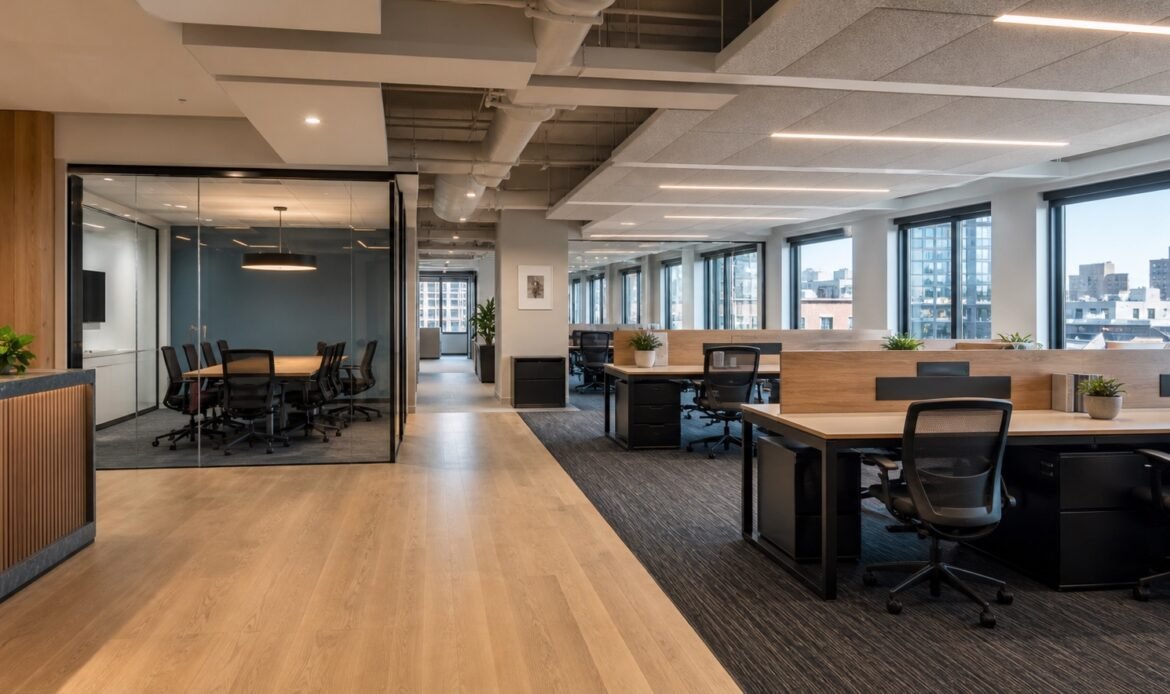
An office renovation affects much more than finishes. It can change how employees move through the space, how clients arrive, how departments collaborate, and how building systems support daily work. It can also create questions for a landlord, property manager, facilities team, IT vendor, security provider, and the people responsible for keeping the business open.
For Queens businesses, the strongest starting point is a written planning checklist. It gives the project team a common set of assumptions before drawings, pricing, phasing, or a target move-in date are treated as final. It also makes proposals easier to compare because each contractor is responding to the same business goals and site conditions.
BluRock Services provides office renovation services in Queens for existing workplaces, tenant fit-outs, office reconfigurations, conference rooms, reception areas, breakrooms, shared amenities, interiors, finishes, and coordinated building-system work. Use this guide to organize the questions that should be answered before a commercial renovation proposal becomes the basis for a project.
Define the business problem before the construction scope
The first question is not which flooring, lighting, or paint color to choose. It is what the renovated office needs to do better.
The goal might be to create more usable workstations, improve privacy, add meeting capacity, update reception, support hybrid work, prepare a tenant suite, improve circulation, refresh worn finishes, or reorganize a space that no longer matches the team. Different goals create different scopes even when two offices have similar square footage.
Write down who uses the office, which areas are under pressure, what must remain operational, and which changes would produce the most practical improvement. Separate required work from optional upgrades. That distinction helps the design and construction teams protect the core business outcome when the scope is refined.
Questions to answer
- Who uses the space now, and who may use it after the renovation?
- Which rooms or functions are missing, undersized, poorly located, or underused?
- Does the project support an existing operation, a new lease, a move, a consolidation, or a change in how the team works?
- Which areas must remain available throughout construction?
- What technology, furniture, security, storage, or accessibility needs affect the layout?
- Which decisions belong to the tenant, owner, landlord, or building manager?
Document existing conditions and scope boundaries
An office proposal is only as useful as the information behind it. Before contractors price the work, gather the suite address, floor, approximate area, current layout, available drawings, photos, lease information, building handbook, known restrictions, and a list of systems that may be affected.
Existing conditions can change the amount of demolition, protection, patching, trade coordination, and investigation required. A finish refresh is different from a reconfiguration that moves walls, alters ceilings, changes doors, or affects power, lighting, HVAC, plumbing, fire protection, or data. A proposal should state which conditions have been observed and which assumptions still need confirmation.
Scope boundaries matter too. Furniture, signage, data cabling, access control, AV, appliances, specialty equipment, window treatments, and move services are often provided by different vendors. The project team should decide who is responsible for design, purchasing, delivery, installation, testing, and final coordination for each item.
Review the lease, landlord rules, and building procedures
Commercial offices operate within building procedures that can affect both pricing and sequence. Before discussing a firm construction plan, collect the alteration agreement or applicable lease provisions and ask the landlord or property manager for current contractor requirements.
The project may need to account for approved work hours, after-hours access, freight-elevator reservations, loading-dock rules, security check-in, temporary protection, insurance documentation, noise limits, debris routes, shut-down requests, fire-alarm procedures, keys, badges, and closeout submissions. These conditions vary by property and should not be assumed from another building.
Ask who reviews the proposed scope, who approves drawings, who coordinates building access, and how much notice is required for deliveries or system interruptions. Put these rules in the bid documents so every contractor includes the same obligations.
Determine whether drawings, filings, or specialized review may be needed
Do not treat permit and approval questions as a final administrative step. The project type, existing conditions, occupancy, systems, and building requirements can affect whether professional drawings, filings, trade permits, inspections, or special inspections are involved.
The NYC Department of Buildings commercial and mixed-use alteration checklist describes owner responsibilities that may apply to permit-dependent alteration work, including registered design professionals, approved construction documents, licensed or registered contractors, inspections, and closeout. The exact path depends on the project, so the owner and project professionals should confirm what applies before work starts.
Ask the contractor how the construction scope will be coordinated with the architect, engineer, filing representative, landlord, specialty trades, and inspection team when those roles are required. Avoid promises that a project will not need review until the actual scope and property conditions have been evaluated.
Decide whether the office will be vacant, occupied, or phased
An empty suite and an active workplace are not the same construction environment. If employees, tenants, clients, or building staff will use part of the office during the project, the scope needs a business-continuity plan.
Occupied work may require temporary partitions, protected routes, daily cleanup, staged deliveries, adjusted work hours, temporary power or data arrangements, departmental moves, swing space, or partial turnovers. Some tasks may be incompatible with normal operations in nearby areas. The team should identify those conflicts early rather than relying on informal day-to-day decisions.
Compare these phasing questions
- Which rooms or departments can move, and when?
- What entrances, corridors, restrooms, exits, elevators, and service areas must remain available?
- Which tasks create noise, dust, odor, vibration, or shut-down requirements?
- How will temporary barriers, protection, housekeeping, and restricted areas be managed?
- Who communicates construction notices to employees, tenants, visitors, and building staff?
- Can the project be divided into logical phases without creating repeated demolition or rework?
- What must be complete before a team can return to a renovated area?
Coordinate the systems behind the visible finishes
Walls and finishes are only part of an office renovation. Layout changes can affect electrical distribution, lighting, HVAC, sprinklers, fire alarm devices, plumbing, data, AV, security, access control, doors, hardware, ceilings, and signage.
Create a responsibility matrix before pricing. For every system, identify the designer or vendor, the work included in the general construction scope, owner-supplied items, building connections, testing responsibility, required approvals, and the information needed from other trades.
This is especially important for furniture plans and technology. Workstation power, floor boxes, wall outlets, monitor locations, conference-room AV, wireless coverage, equipment cooling, security devices, and data pathways should be coordinated with the final layout. Late changes can affect finished walls, ceilings, millwork, and flooring.
Make selections and procurement visible
An office scope often includes flooring, paint, wall coverings, ceilings, lighting, glass, doors, hardware, millwork, plumbing fixtures, appliances, signage, and specialty products. Each selection needs an owner, approval date, purchasing responsibility, and delivery plan.
The contractor should distinguish fixed selections from allowances or placeholders. If an exact product is not yet chosen, the proposal should explain what basis has been carried and what happens when the final selection differs. The team should also identify products that require field measurement, shop drawings, samples, mockups, or coordination with existing building standards.
Avoid committing to a finish package based only on appearance. Review durability, maintenance, cleaning, replacement access, acoustics, slip resistance where relevant, compatibility with the intended use, and how adjacent materials meet.
Compare office renovation proposals on the same assumptions
The lowest number is not automatically the clearest proposal. A useful commercial renovation proposal lets the owner understand what is included, what is excluded, and which decisions or unknowns may change the scope.
Ask each bidder to respond to the same drawings, narrative, phasing plan, building rules, finish schedule, and responsibility matrix. Then compare work areas, demolition, protection, temporary conditions, trade scope, material basis, allowances, work hours, access, cleanup, owner-supplied items, inspections, closeout, and change procedures.
Proposal checklist
- Clear description of each work area
- Referenced drawings, revisions, and written assumptions
- Included and excluded construction activities
- Material, fixture, and finish basis
- Allowances and unit-price assumptions, if any
- Building access, freight, protection, and work-hour requirements
- Occupied-space or phasing responsibilities
- Trade and vendor coordination boundaries
- Permit, inspection, testing, and closeout responsibilities when applicable
- Owner-supplied items and required decision dates
- Change documentation and approval process
- Cleanup, punch-list, turnover, and final-document expectations
If two proposals rely on different assumptions, normalize them before making a decision. A contractor that includes protection, building coordination, after-hours work, or specialty interfaces may appear higher than a proposal that leaves those responsibilities undefined.
Establish communication and decision ownership
Commercial renovation decisions often involve several people. Name the owner representative who can approve scope and changes. Also identify the landlord contact, building manager, designer, contractor project lead, site contact, IT lead, furniture vendor, security vendor, and any other decision-makers.
Agree on how submittals, requests for information, field questions, progress updates, construction notices, and change requests will be documented. Decide who attends meetings and how quickly time-sensitive questions should be routed. The goal is not to promise that no surprises will occur; it is to create a reliable way to evaluate them.
Plan turnover and closeout before construction begins
Turnover should be part of the original scope. Define what must be complete for the business to occupy or reopen an area, and distinguish that milestone from final completion of every minor punch-list item.
The closeout plan may include final walkthroughs, punch lists, cleaning, keys, badges, access devices, system testing, control information, product data, care instructions, owner training, inspection records, sign-offs, and a list of remaining items. The exact requirements depend on the property and scope.
Ask who will compile closeout documents and where they will be stored. A property manager or facilities team should be able to find the final information without reconstructing it from separate email threads after the project is over.
Questions to ask an office renovation contractor
- What information do you need before the scope can be priced reliably?
- How will you document assumptions, exclusions, allowances, and owner-supplied items?
- What building procedures need to be included in the plan?
- How will occupied areas, temporary routes, protection, and daily cleanup be handled?
- Which systems and specialty vendors need early coordination?
- How will drawings, landlord comments, and project-specific approvals be incorporated?
- Who leads communication with the owner, building team, and field trades?
- How are field discoveries and requested changes documented before work proceeds?
- What selection and procurement decisions must be made before construction?
- What is included in punch, turnover, and closeout?
Frequently asked questions
What do office renovation services usually include?
The scope can include existing-condition review, selective demolition, protection, partitions, ceilings, flooring, paint, millwork, doors, hardware, lighting, and coordination with building systems and specialty vendors. The actual work depends on the lease, property, drawings, intended use, existing conditions, and approved project scope.
Can an office renovation happen while the business stays open?
Sometimes. The answer depends on the work, space, building rules, safety needs, access, noise, dust, systems, and available swing space. A written phasing and business-continuity plan should explain which areas remain active and how work zones are separated and coordinated.
Who should be involved in planning a commercial office renovation?
The group may include the tenant or owner, landlord, property manager, facilities lead, contractor, registered design professional when required, IT, security, furniture and AV vendors, specialty trades, and building staff. Assigning decision ownership early helps prevent gaps.
Does every office renovation in Queens need a permit?
Not every scope follows the same path. Project type, occupancy, structural work, layout changes, plumbing, mechanical, fire protection, electrical work, and other conditions can affect requirements. Confirm the project-specific path with the appropriate building team and qualified professionals before work begins.
How should I compare office renovation proposals?
Compare proposals against the same drawings, written scope, phasing assumptions, building rules, finishes, systems, work hours, protection, exclusions, allowances, specialty responsibilities, changes, inspections, and closeout requirements. Resolve differences before comparing totals.
What should I give a contractor before requesting a quote?
Provide the address, floor or suite, business goals, approximate area, photos, available drawings, lease or alteration requirements, desired layout, occupancy plan, building procedures, known system needs, finish direction, and owner-supplied items. The contractor can then identify what needs further review.